Friday, May 10, 2019

More Revisionist "Science"

There have been a number of posts circulating recently about whether wind turbines can ever produce enough energy to pay back what went to making them.

This article examines the numbers.  Their conclusion is that a normal wind turbine will reach payback in about 6 months.

This article also addresses the topic, reaching approximately the same conclusions.

And then there are the posts that claim electric cars actually pollute more than those with diesel engines.
The Tesla Model Y. Photo: Tesla

This article examines those numbers.  The basic conclusion is that electric cars will be on the positive side of the energy saving ledger between 6 months to a year or so.  And, of course, when batteries DO need to be replaced, they are too valuable to just throw into the dump.  They are repurposed, recycled or otherwise used in ways that gain additional value from the materials that went into making them.

And finally,, for today, there is this notion among climate change deniers that Canada doesn't need to do anything because we have all these trees.

While it is true that we have trees, which act as a carbon sink, forests also emit carbon, so the story is a bit more complex than initially told.  

This article from Policy Options looks at the issue and concludes that Canada's forests haven't been a net carbon sink for about 10 years.  Of course, it varies from year to year, but, in the final analysis, our forests and our land mass just do't store more carbon than we emit.


Friday, April 19, 2019

A Profound Disappointment

But perhaps no great surprise either.

As many will know, I spent my teaching career in a small, rural Saskatchewan community.  That career ended with my retirement 15 years ago, but it's been interesting to remain in contact with a large number of former students as they move into careers of their own, families of their own and, hopefully, more informed opinions of their own.

It was with some disappointment, the other evening, that I was involved in another exchange involving the oil and gas industry, climate change, the carbon tax and other peripheral issues that have been dividing this country for a few years now.

The post that got this most recent "discussion" going was another in a series that promotes the Trans Mountain Pipeline and points to a single spill as evidence of how safe pipelines are.  Never mind that the article pretty much misses the point about the other problems that increased tar sands production and increased oil use presents.

I countered with a Global News video that looked at the number of pipeline spills in Alberta.  Note that this article doesn't include any pipelines under NEB (National Energy Board) jurisdiction, such as those crossing provincial boundaries.

Ever protective of their pet industry, a few former students weighed in, mostly with ad hominen comments related to my choice to commute to work in their town, questions about whether I had taken any plane flights recently, and what was I doing to own up to my personal carbon footprint.

What they didn't do was address the content of the Global News article.

I countered with an article from the Western Producer about Alberta's huge orphan wells problem, one variously pegged at costs between $50B and who knows where.  A problem for which there is a mere pittance available to fund the cleanup of those wells that comes from the industry itself.  It's pretty obvious that most of the cost will fall in the shoulders of taxpayers.  I can't wait for the future to prove me wrong on this, but I don't expect to be.

Still no response  directed to the articles presented, but certainly more comments about how I must know nothing about industry, life on the farm or anything else about "real life" because, mainly, I was a teacher (of science, among other things) for most of my working life.

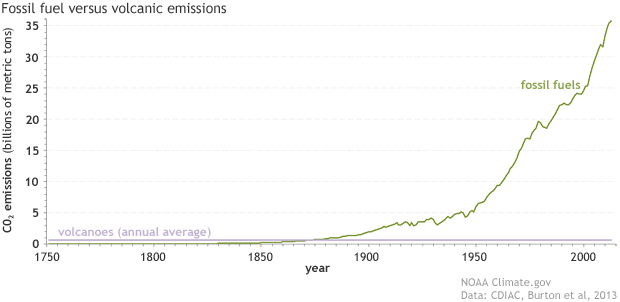
It wasn't difficult to detect the arrogance of such claims coming from people who know almost nothing about science but still feel comfortable dismissing climate change.  In this vein, the following canard was trotted out - how volcanoes contribute so much to CO2 emissions, far more, in fact, than humans ever have.


It's profoundly disappointing to see people who had access to the educational opportunities provided in a developed country and yet were so incapable of doing 10 seconds of research on the Interweb to find clear, unequivocal answers to these topics.

For instance, here, from Scientific American and the US Geological Survey.

Or here, in an article published in Forbes, a reasonably reputable business magazine.

Or here, from the website Skeptical Science, although I didn't use this one, knowing that climate change deniers will have no truck with anything found on that site.

Or here, from the US Government itself, but we all know that governments worldwide are in on the "climate change conspiracy" in a desperate grasp for power, tax revenue and control.

Those sources took me about 2 minutes to find.  Even the first one, given the source, would likely have been enough.  My science education and related experience over 4 decades has taught me a few things:  I'm cautious about declaring what I know.  I'm not an expert, but I recognize that there are experts who know more than I do about most things.  I adhere to the cautious position that science has on knowledge, recognizing that new information can appear at any time, making current explanations (not beliefs - that's the purview of religion and politics) subject to change.

Not these fellows, though.  Despite their science education being limited to a few years (apparently for little discernible result) in high school science classrooms, they are comfortable dismissing information as clear as the following:

Volcanic versus anthropogenic CO2 emissions

This volcano trope was first proposed by geologist Ian Rutherford Plimer in his book Heaven and Earth.  In his book he tries to argue that humans have an insignificant effect on global climate.  His book has been widely discredited.  Empirical evidence almost by itself would be enough to discredit such nonsense.  But "arguments" similar to his are regularly trotted out by climate change deniers and fossil fuel enthusiasts.

This is not the only case that leaves me with my sense of profound disappointment.  Another former student is, so far as I can tell, firmly in the anti-vax camp.  I've resisted bringing the topic up, but I fear for her children.  Her beliefs stem from a completely discredited article published by Andrew Wakeman several decades ago.  Unfortunately, once nonsense gets out there, it's nearly impossible to walk it back.


Another former student has apparently spent far too much time listening to American talk radio and has a veritable compendium of conspiracy theories and related nonsense to trot out at any given time.  As the talk became even wilder and far-fetched, I had to give up talking to him.

And yet another let loose with a collection of comments such as: "You don't see Smart cars pulling horse trailers", "climate alarmists are declaring fossil fuels irrelevant", and that if people had to pay these increased costs [from the minuscule carbon tax] they wouldn't be able to afford to "go green".    

It should be obvious to anyone that when people have lots of money, they spend it on toys.  Large trucks, ATVs, boats, big 5th-wheel trailers, vacations, etc.  They certainly don't spend that extra cash on more energy efficient vehicles, or home insulation upgrades.  The only time people will invest in anything more energy efficient (and keep in mind that few people even think about this topic much), is when they finally see that they can save money by doing so.  And why would they start paying attention to this?  When something costs you more that it used to, especially when it costs quite a bit more than it used to.

Frankly, I don't much care what people spend their money on, but they shouldn't expect there to be no consequences for their purchases.  The costs of running them would be top of the list.  At some point, most thinking people will realize that they can't afford NOT to invest in greener technology.

My life experience taught me that if I wanted to do something (buy a big truck, go on a vacation, etc), I had to be able to afford it.  If not, I needed to find another way.  But I had no right to expect the world to hand me whatever I wanted for no cost.

Where this anti-knowledge, anti-science mindset comes from would be interesting to discuss, but I can point to a meeting I had with one of the local Board of Education members, many, many years ago, during which he accused me of "pushing my own opinions", specifically, at the time, about acid rain.  What it was quite obvious he didn't understand or accept, was that acid rain was a real problem and that I had been hired to teach science and was, therefore, at least passingly aware of the acid rain issue.  What I taught were not "my opinions", but the accepted view of the mainstream science.  The same could be said about the teaching of genetics, evolution, chemistry, or climate change.  It was perhaps my first encounter with the small-c conservative party line as it relates to science.  Deny, deny, deny.  And, as we saw during the Harper regime, try to muzzle anyone who has opinions different from your own.


And, of course, we all know that science types are just pointy-headed intellectuals with no grounding in real life and the way the world actually works.

Tempering my disappointment is the knowledge that other former students have become exceptionally well-informed about many issues and who are prepared to discuss, intelligently, many of the important issues of the day.  Not that we always agree, but that's not the point.  It never is the point.

Unfortunately, we have to go back to the recent Alberta election.  The UCP posted the following image on their Facebook page and some of their obvious supporters have taken great joy in re-posting it.  Also, unfortunately, it doesn't say much for their level of knowledge of science, atmospheric pollution, air quality and climate change.  


It's all really quite sad.  Trumpism has come to Canada and lives here in the form of Ontario's Ford, Alberta's Kenney, Saskatchewan's Moe, Ottawa's Scheer and all the many people who think these jokers are the greatest.  And just when we thought getting rid of Harper was going to give us our country back.


Alberta's "Problems"

And the Globe and Mail weighed in....

No one should feel sorry for Alberta.

Kenney's Win, Trudeau's Gain?

iPolitics weighed in on this issue the other day

It's a good article, as articles in iPolitics usually are. 

Of course, Jim Prentice had it right when he made that off-hand comment about Albertans "looking in the mirror" to see why the province was in trouble. And Albertans tossed him too. 

The author's comment about it being a long hot summer in BC is correct. If it's another devastating fire season out here and we go through another month or two of choking smoke everywhere, and we see Alberta trashing the carbon tax and (more importantly) any other strategies of dealing with climate change, there are gonna be a LOT more BC residents pretty angry. We have spent the past 2 summers with valuables packed up, ready to evacuate with an hour's notice. This is one of the realities of climate change in this part of Canada. 


Idiots like Scheer, Kenney, Moe and Ford might resonate with the "drill, baby, drill" crowd, but out here we see it as political opportunism and a total disregard for the environment. And if that makes me an environmental extremist, bring it on. I was pretty unhappy with Notley and her full-steam-ahead approach to pipelines and tar sands development, but at least there were baby steps in the form of a carbon tax and closing coal-fired power stations. Now that those are gone, there is NO reason to hold your nose and look the other way while another pipeline is built and more tar sands are developed to ship even more oil out of the country.


Tuesday, December 18, 2018

No Oil on These Troubled Waters

This "discussion" about oil pipelines, oil prices and Alberta's place in Confederation is really shifting into high gear.  

The issue, as everyone in Canada surely knows, is that Alberta hasn't been able to get its oil to markets, at least to "other" markets, specifically to places other than to the USA, and, as a consequence, there is a backlog of oil that can't get shipped and there is a price discount because there is an oil glut and the matter of the difficulty of refining the tarry stuff that the tar (aka: oil) sands produces.....  It's a significant issue in Alberta and lots is being said about it.  So.

First, let's take a quick look at some assertions about how important Alberta oil is to the Canadian economy.

I've been told, by a few people who should know, and by some politicians who ought to know, that the energy sector is 20% of Canada's GDP.  

All I could find was this:  The total value of the energy sector is 10% of Canada's GDP.   That includes everything - gas stations, electricity, oil and gas, everything related to energy.  Oil and gas contribute about 4% of Canada's GDP and the oil sands is a mere 2% of GDP.


So my question is why do some people seemingly overstate the value of the oil sands sector, in particular, to the Canadian economy?  It's important to Alberta and Saskatchewan, absolutely, and it does contribute to Canada's overall economy, but it's a long ways from being the only game in town.  And as for jobs, the energy sector as a whole generates 2.6% of direct employment to the Canadian economy.

If you want to see how this compares with the auto industry, you can get some information here.

According to the Parkland Institute, the Big Five in the Oil Sands (eg: Suncor, Cenovus, CNRL) had net profit rates above 13.5% in 2017 (Cenovus was closer to 19%).  Which raises the question: Why do taxpayers subsidize the oil and gas industry to the tune of billions each year?  

Canada contributes about $3.3B to the oil and gas sector in various types of subsidies each year.  The article also considers what other uses such money could be put to.  World-wide, subsidies amounted to about $375B in 2015.  On December 17th, 2018, the Federal Government announced another $1.6B in aid (subsidies) to the oil sector.  One would hope this won't be just more money poured into a black hole as was done with the auto sector back in 2008.

So why, given their obvious profitability and the subsidies courtesy the Canadian taxpayer, why are we still paying any attention to cries for help in propping up these businesses?

And given the urgency of dealing with climate change, why are energy companies allowed to expand oil sands production?  The Parkland Institute's article considers that matter as well.


Sunday, December 02, 2018

Jim Crow by the Back Door

The New Jim Crow - Mass Incarceration in the Age of Colorblindness

by Michelle Alexander


Many statistics would seem to bear out the author's contention that the War on Drugs (itself, a failed policy) has served to "keep blacks in their place", essentially in the same way that slavery, and later, the Jim Crow laws, served to do.

As the NAACP's website shows:

  • Between 1980 and 2015, the number of people incarcerated in America increased from roughly 500,000 to over 2.2 million.
  • Today, the United States makes up about 5% of the world’s population and has 21% of the world’s prisoners.
  • 1 in every 37 adults in the United States, or 2.7% of the adult population, is under some form of correctional supervision.
  • In 2014, African Americans constituted 2.3 million, or 34%, of the total 6.8 million correctional population.
  • African Americans are incarcerated at more than 5 times the rate of whites.
As the author points out, a very large proportion of those people in prison ended up there as a result of a conviction for minor drug offenses - possession of marijuana, for example.  And most of them caught up in this have been blacks, despite the fact that drug use is at least as prevalent among white people.  The way the War on Drugs has been enforced has disproportionately targeted blacks, especially young, black, males.

This has had a major impact on black communities across America.  Reduced access to education, housing, jobs and even the right to vote. 


As they say: plus ça change, plus c'est la même chose


Saturday, November 24, 2018

Who You Gonna Believe?

When it comes to most matters, especially anything to do with science, it would appear that there's at least one person you can't rely on:


Keep in mind, this report was issued by the American government's own people.

Some have expressed this lack of confidence more directly, as reported in this article from the Huffington Post.  This fake Time cover does seem to go well with the article, though.


Unquestioning supporters are unmoved, apparently.  As the sign in the picture puts it: "Make the Earth Flat Again".  Good luck with that.